
What does the September 2026 spam update mean for AI-assisted blogs?

The September 2026 spam update is an improvement to Google's automated spam detection, released on 24 September 2026, applying globally and to all languages, with a rollout window of up to two weeks. Below: what Google's policies say about AI-assisted posts, our own engine's draft audit from one day into the rollout, a worked example to redo on your queue, our labelled view and a checklist to download.
Does Google penalise blog posts written with AI?
No. Google judges a page by its value to readers, not by the tool that drafted it. Its February 2023 Search Central blog post on AI-generated content says: "Appropriate use of AI or automation is not against our guidelines." Its guidance on using generative AI content, updated on 1 October 2026, names the exception: "using generative AI tools or other similar tools to generate many pages without adding value for users may violate Google's spam policy on scaled content abuse."
That policy draws the line at volume without value. Google's spam policies define scaled content abuse as "when many pages are generated for the primary purpose of manipulating search rankings and not helping users", and say it is "typically focused on creating large amounts of unoriginal content that provides little to no value to users, no matter how it's created."
The better test is the question Google's guide to its generative AI search features asks site owners: "Is this content that my visitors would find satisfying?"
Is the September 2026 spam update finished?
Not as of 6 October 2026, the date we last checked Google's Search Status Dashboard. The incident shows a start of 09:15 Pacific Daylight Time on 24 September and one message: "Released the September 2026 spam update, which applies globally and to all languages. The rollout may take up to two weeks to complete."
Two weeks from 24 September is 8 October 2026. Google closed its August 2026 spam update with the line "The rollout was complete as of August 21, 2026." Until a line like that appears on the September incident, Google has not confirmed that the rollout is complete.
The message does not name a target. Google's spam updates page tells sites that see a change to "review our spam policies", so those policies, last updated on 28 August 2026, are the guide.
Which Google spam policies matter most for an AI-assisted blog?
For a company blog, watch scaled content abuse and scraping, plus a warning in Google's generative AI search guide against a post for every variation of a query.
| Policy, and where Google says it | Google's wording | What it looks like on a company blog | Checklist item below that catches it |
|---|---|---|---|
| Scaled content abuse (spam policies) | "Stitching or combining content from different web pages without adding value" | A post assembled from the current top results, with no data, example or view of your own | Something the top results lack |
| Query variations (generative AI search guide, citing the scaled content abuse policy) | "While it might be tempting to create separate content for every possible variation of how people might search ... doing so primarily to manipulate rankings or generative AI responses in Google Search violates Google's scaled content abuse spam policy" | Separate posts on "AI for invoicing", "invoicing with AI" and "best AI invoicing tool" that give the same answer | One topic |
| Scraping (spam policies) | "Copying content from other sites, modify it only slightly (for example, by substituting synonyms or using automated techniques), and republish it" | A competitor's guide run through a paraphrasing prompt | Specific to you |
Google's guidance on using generative AI content also asks for a human fact-check of every AI draft: "It is critical to manually factcheck and review all AI-generated content for accuracy and trustworthiness before publishing." The same page extends that review to titles, meta descriptions, structured data and image alt text.
What did our own content engine find when it checked its drafts?
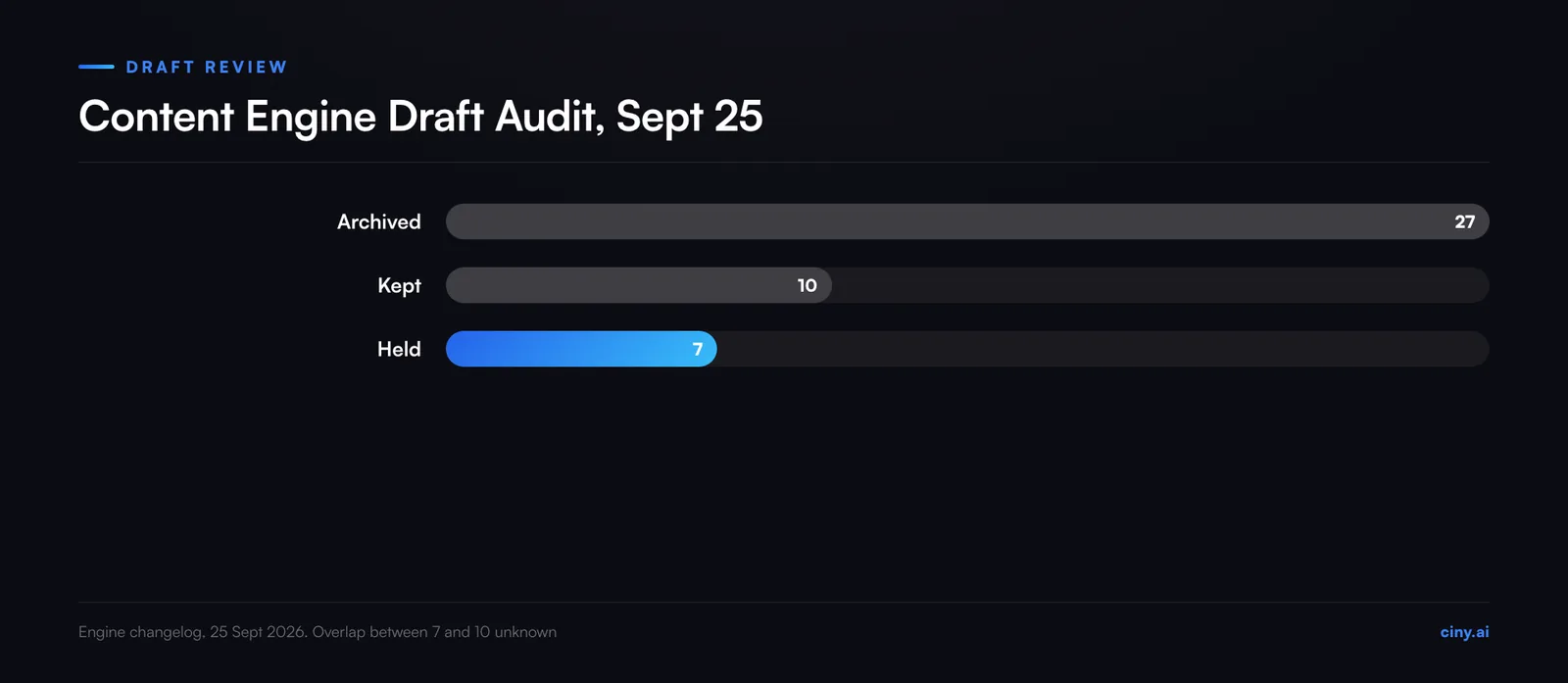
Our engine archived 27 drafts that failed our page pattern and kept 10 that passed, and one publishing route had been skipping a check. It recorded both findings on 25 September 2026, one day into the rollout. The engine runs the Ruh AI blog, which is moving from generic AI topics to construction, and our Ruh AI case study covers that site's measured results. These are one site's figures, not a study of the web.
Our page pattern, adopted on 21 September 2026, asks every long-form post for a quotable definition, a real-figures table, a redoable worked example and a labelled opinion. The keyword-freeze check is a separate rule: it holds any draft that targets a search term we are still measuring, because a new post on that term would compete with the page under test and spoil the reading.
All four figures come from our content engine's change log entry for 25 September 2026.
| What was recorded | Figure | What it does not show |
|---|---|---|
| Drafts that failed the page pattern (no data table, no labelled opinion), archived and removed | 27 | Whether Google would have treated any as spam |
| Drafts that passed and were kept | 10 | How they will rank, or whether they passed every later check |
| Drafts held by the keyword-freeze check on its first run after the fix | 7 | Whether these overlap with the 10 kept |
| New construction-focused pieces queued through our full set of checks | 2 | Any result yet |
Why does every publishing route need the same checks?
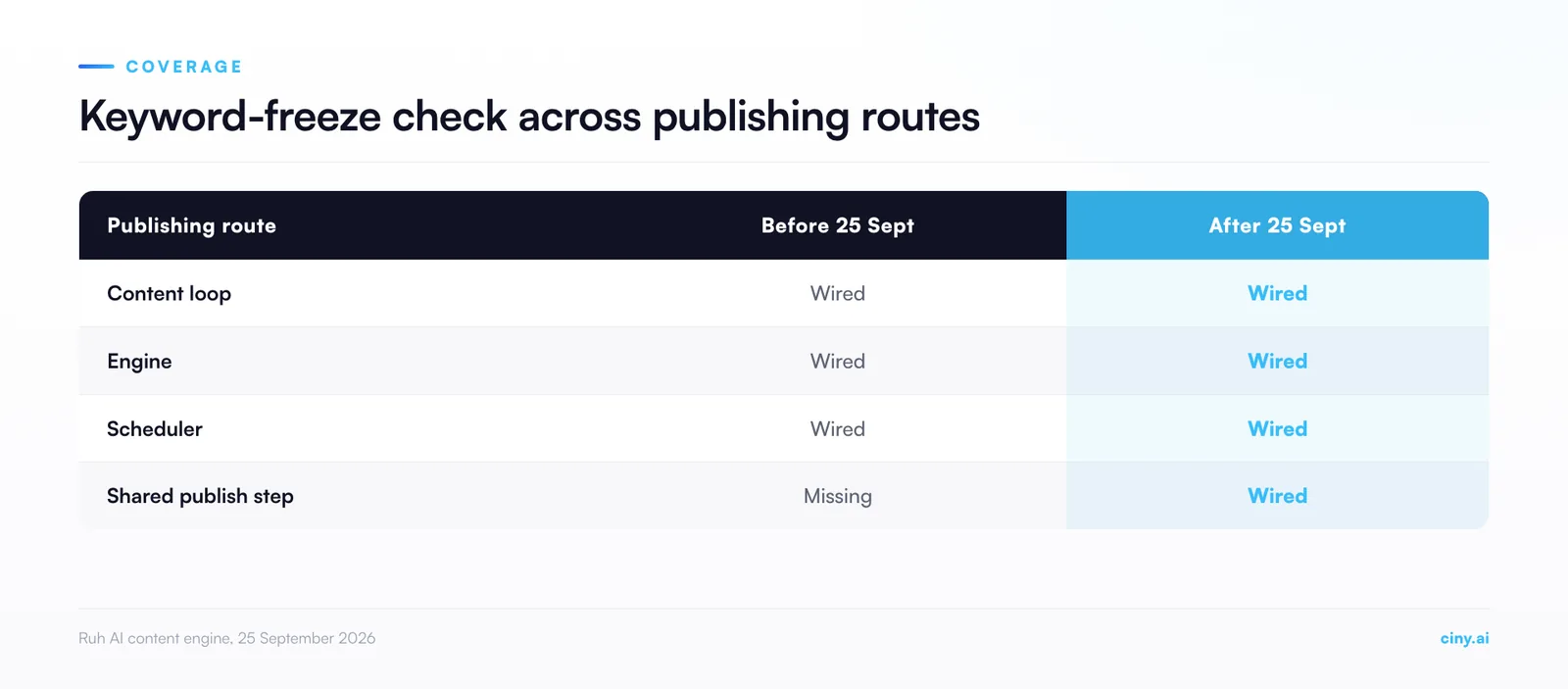
Because a check protects only the routes it is wired into. Our keyword-freeze check was wired into the content loop, the engine and the scheduler, but not into the shared publish step that the content calendar and every manual push use. Daily publishing had been running through that step without it.
A review of draft wording would not have found this, because the gap was in the wiring, not in the text. We wired the check into the shared publish step and confirmed it in the live system. The freeze check protects our measurement, not our spam compliance, but the lesson holds for any check you rely on, including the page checks you use against scaled content abuse.
Most teams have several ways to publish a post, such as a scheduler, a calendar and a CMS button. List every one and confirm each runs the same checks.
How many drafts in your queue are clear to publish?
Take all the drafts you checked, then subtract the ones that fail your page checks and the passing ones on a term you are still measuring. Here is that arithmetic on our 25 September figures.
- Drafts checked (A): 27 failed + 10 passed = 37. We assume these were the whole set checked that day, because the change log records no other drafts.
- Drafts that fail your page checks (B): 27, which is 27 ÷ 37, about 73% of the queue.
- Passing drafts on a term you are still measuring (C): between 0 and 7. The freeze check held 7, and the log does not say how many were among the 10 that passed.
- Clear of both checks = A − B − C. If all 7 were among the 10, that is 37 − 27 − 7 = 3. If none were, it is 37 − 27 − 0 = 10. So between 3 and 10 drafts were clear of both checks that day.
Your version: write down A, B and C with today's date, then publish only what is left after every other check you run. This measures your queue against your own standard, which is the part you control. It cannot tell you whether Google would treat an archived draft as spam.
What do marketing leads get wrong about AI content and spam updates?
Our view: Treat publishing routes as part of editing. Every check belongs on every route, and any new way to publish, whether a calendar, a manual button or an integration, needs the same checks before it sends out a single post.
Archive before you rewrite. Polishing the sentences of a draft with no data and no point of view gives it neither. We archived every draft that failed our pattern, and our engine now plans each piece's table, worked example and opinion before writing starts.
Do not judge your numbers mid-rollout. Movement before Google's completion notice is incomplete. Read it after the notice, against a period before 24 September.
Stop counting ranking keywords for long-form posts. On 21 September we moved our own measure to tool runs, downloads and leads, which show that a reader did something with the post. Ruh AI's marketing stand-up that day recorded overall traffic dropping on purpose as the site moves away from generic AI content. A keyword count would score that as a loss.
The pre-publish checklist for AI-assisted blog posts
Run these ten checks on every draft, on every route that can publish it. Copy the list into your brief template or CMS, or download the checklist as a Markdown file. No email needed.
- Reader and task. One sentence names who the post is for and what they can do after reading it.
- Something the top results lack. Your own data, a worked example, a template, first-hand experience or a labelled view. "Better written" does not count.
- One topic. No other post on your site answers the same question for the same search term, and this post is not one of a set written for different phrasings.
- Every figure sourced. Each number names its source and date in the text. No invented statistics, quotes, clients or results.
- Google claims checked today. Every statement about Google policy is checked against Google's own page, with the date.
- Facts in the text. Every number in an image or chart also appears in the body copy.
- Metadata fact-checked. Title, meta description, structured data and alt text get the same review as the body.
- Who and how. A byline and, where readers would ask, one line on how AI was used.
- Not on a term you are measuring. The target term is not one you are still measuring, and this check runs on the scheduler, the calendar and the manual publish button alike.
- Specific to you. No sentence could sit unchanged on a competitor's blog.
For the longer editorial process behind these checks, read our guide on how to review AI-assisted content.
Frequently asked questions
Can I still use ChatGPT or other AI tools to write blog posts?
Yes, as long as each post adds something for readers. Google's concern is many posts made without value, however they were made.
Do I have to label AI-assisted blog posts?
Google Search does not require a label on a blog post, though Merchant Center has its own rules for product data. Google does recommend telling readers how a post was made. Its guidance on using generative AI content suggests "adding information on how your content was created in a way that makes sense for your audience", and its people-first guidance asks: "Is the use of automation, including AI-generation, self-evident to visitors through disclosures or in other ways?" One line near the byline is the simplest answer.
Should I delete old AI-written posts now?
Not in a hurry. Improve posts that can carry real data or a real view, merge overlapping posts into the strongest one with a redirect to that post, never to the homepage, and delete last, with a record of what went and why.
How long does recovery from a spam update take?
Google gives no fixed timeline and makes no promise. Its spam updates page says: "Making changes may help a site improve if our automated systems learn over a period of months that the site complies with our spam policies."
Sources
Google, all checked on 6 October 2026:
- Google Search Status Dashboard, September 2026 spam update: https://status.search.google.com/incidents/XhUDXP7A67iHCD2kmbVu
- Google Search Status Dashboard, August 2026 spam update: https://status.search.google.com/incidents/LEubPCm2octf2uMqCFKE
- Spam policies for Google web search, last updated 28 August 2026: https://developers.google.com/search/docs/essentials/spam-policies
- Google Search's guidance on using generative AI content on your website, last updated 1 October 2026: https://developers.google.com/search/docs/fundamentals/using-gen-ai-content
- Optimizing your website for generative AI features on Google Search, last updated 10 July 2026: https://developers.google.com/search/docs/fundamentals/ai-optimization-guide
- Creating helpful, reliable, people-first content, last updated 5 October 2026: https://developers.google.com/search/docs/fundamentals/creating-helpful-content
- Google Search spam updates and your site, last updated 10 December 2025: https://developers.google.com/search/docs/appearance/spam-updates
- Google Search's guidance about AI-generated content, Search Central Blog, 8 February 2023: https://developers.google.com/search/blog/2023/02/google-search-and-ai-content
Our own evidence, from one site's content engine, not a study:
- Content engine change log, 25 September 2026: the draft audit, the publishing-route fix, the 7 drafts held and the 2 pieces queued.
- Content engine change log, 21 September 2026: the page pattern and the new success measure.
- Ruh AI marketing stand-up notes, 21 September 2026: the stated move away from generic AI content.
What should you do next?
Run the checklist on one draft before it goes live this week. Take the next AI-assisted post in your queue and hold it until all ten boxes are ticked.
If you want the posts already on your blog checked for thin content and answer structure, talk to Ciny about a content audit.