
Website visitor identification: what it finds and where it stops

Website visitor identification is software that names the company, or with person-level tools the person, behind an anonymous website visit, using IP data, cookies and device identifiers. Below: what RB2B says it finds and misses, Ruh AI's 17-day figures with the cost maths, the privacy and opt-out rules, our view and a template to copy.
What does website visitor identification find?
It finds the company behind a visit and, with a person-level tool, the person. Company-level identification names the organisation. Person-level identification returns a named profile you could contact.
RB2B is a person-level tool. Its homepage says: "Get the names, LinkedIn profiles, and email addresses of real people on your site." Its help centre explains that it correlates first- and third-party cookies, device identifiers and IP data to recognise visitors across its network, then enriches each match with professional data.
For each identified visitor, where available, RB2B's help centre lists the first and last name, LinkedIn profile, job title, company, email address, city and state, the date and time last seen, and a count of pages viewed.
What you get depends on the plan. These are RB2B's own prices and coverage claims from its pricing page, checked on 6 October 2026.
| Plan | Monthly price | What you get | Stated US person-level coverage |
|---|---|---|---|
| Free | $0 | Company-level identification sent to Slack, with no person-level identification or email addresses | None |
| Starter | $79 | LinkedIn profile links sent to Slack or Teams, with no email addresses | 15 to 20% |
| Pro | From $149 | Business email addresses and all integrations | 15 to 20% |
| Pro+ | From $199 | Premium resolution, business email addresses and all integrations | 35 to 45% |
Coverage figures are RB2B's own claims, not an independent measure, and its pages differ. The help centre says it identifies about 40 to 45% of what it calls qualified US-based traffic at person level, plus a further 30 to 35% at company level. To test a vendor's coverage claim on your own site, divide the visitors it identified in a period by the US visitors your analytics shows for the same dates.
What does website visitor identification not tell you?
It does not tell you why someone visited or whether they want to hear from you. A profile and a page count describe a visit, not a need. RB2B's help centre says it scores visitors on their likelihood to convert from content engagement, time on page and visit frequency. That score is the vendor's inference from behaviour, not the visitor telling you what they need.
It also leaves gaps in coverage. RB2B's homepage says: "RB2B's Person-Level Identity is a US-only technology with a US-only database." Its help centre says visitors outside the US, or using VPNs, proxies or obfuscation tools, are excluded from person-level tracking. A help centre article dated 9 March 2026 adds that the Starter, Pro and Pro+ plans identify visitors outside the US at company level only, and "no person-level profiles are generated for non-US visitors".
Most important of all, a named visit is not an enquiry. The person did not ask to be contacted, and that should shape how you count these visitors, when you write and what you say.
What did visitor identification find for Ruh AI?
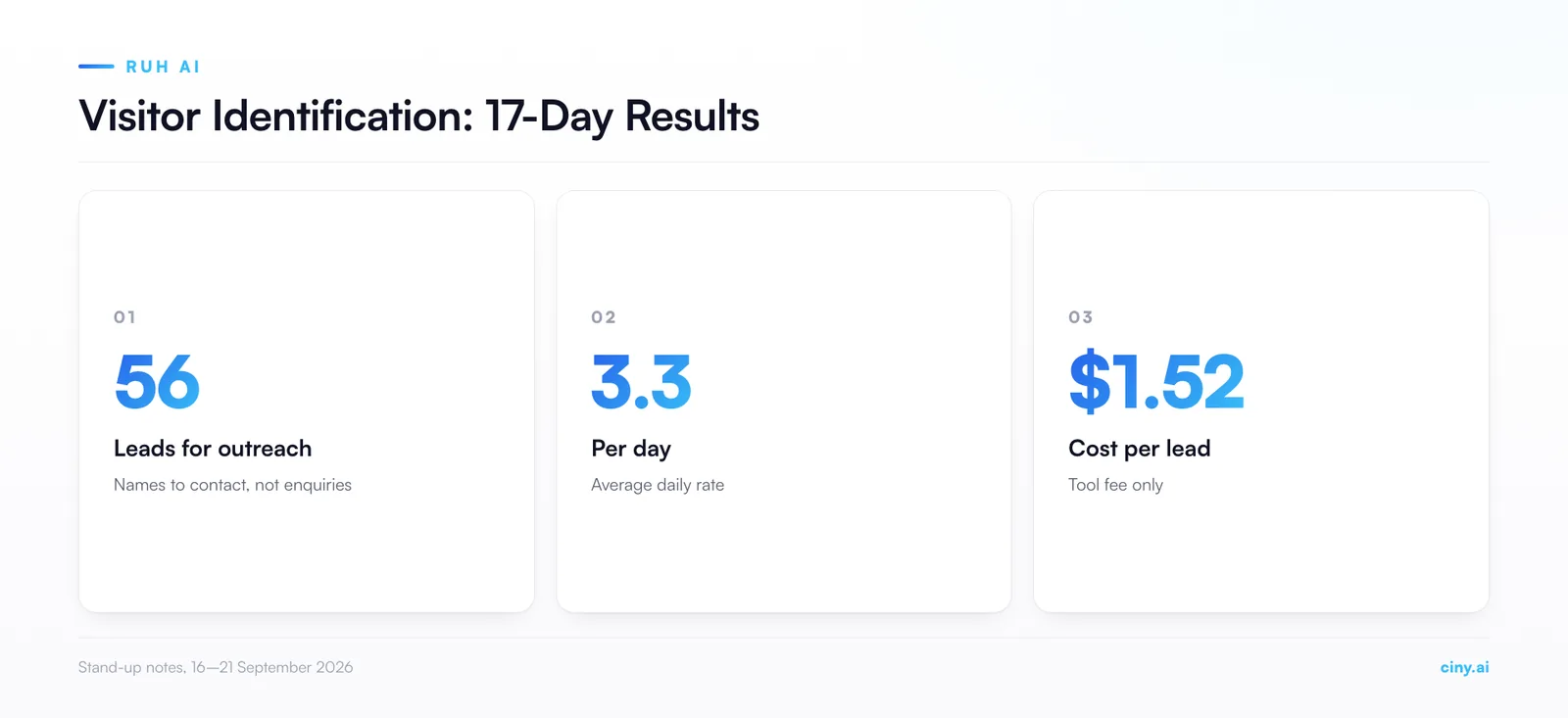
Ruh AI's marketing stand-up on 21 September 2026 recorded 56 leads for cold outreach from RB2B visitor identification over the previous 17 days. These are names to contact, not people who asked to hear from Ruh AI.
Ruh AI is an AI platform for construction teams and Ciny's first customer. Ciny grew out of the marketing system built for it. These are one company's figures from its marketing stand-up notes, not a study.
| What was recorded | Figure | Source | What it does not show |
|---|---|---|---|
| Leads for cold outreach from RB2B visitor identification | 56 in the 17 days to 21 September 2026 | Stand-up notes, 21 September 2026 | Replies, meetings or deals |
| Cost of the visitor identification tool | About $150 a month | Stand-up notes, 16 September 2026 | Staff time spent working the names |
| Outreach timing rule | Wait about a day after the visit | Stand-up notes, 16 September 2026 | Whether waiting changes the reply rate |
The 16 September notes record a visitor identification tool at about $150 a month, sending profiles to Slack, and the timing rule. The 21 September notes record RB2B visitor identification as live, and RB2B lists its Pro plan, the first with business email addresses, from $149 a month.
How many outreach leads a day, and what does each one cost?
On Ruh AI's figures, about 3.3 outreach leads a day, at a tool cost of about $1.52 each, before anyone's time to qualify and write to them. Here is the arithmetic, ready to redo with your own numbers.
- Outreach leads per day: 56 ÷ 17 = 3.29, about 3.3 a day.
- Outreach leads per month at that rate: 56 × 30 ÷ 17 = 98.8, about 99.
- Tool cost for the period: about $150 a month, and 17 days of a 30-day month. $150 × 17 ÷ 30 = $85.
- Tool cost per outreach lead: $85 ÷ 56 = $1.52.
This is the tool's fee only. Add the time spent qualifying and writing to each name before you compare it with another channel's cost per lead.
Your version: leads per day = outreach leads ÷ days. Tool cost per lead = monthly cost × days ÷ 30 ÷ outreach leads. Then redo step 4 with replies, and again with meetings, in place of leads. Those two figures show pipeline, so start counting replies and meetings in the first week.
How do you turn identified visitors into pipeline?
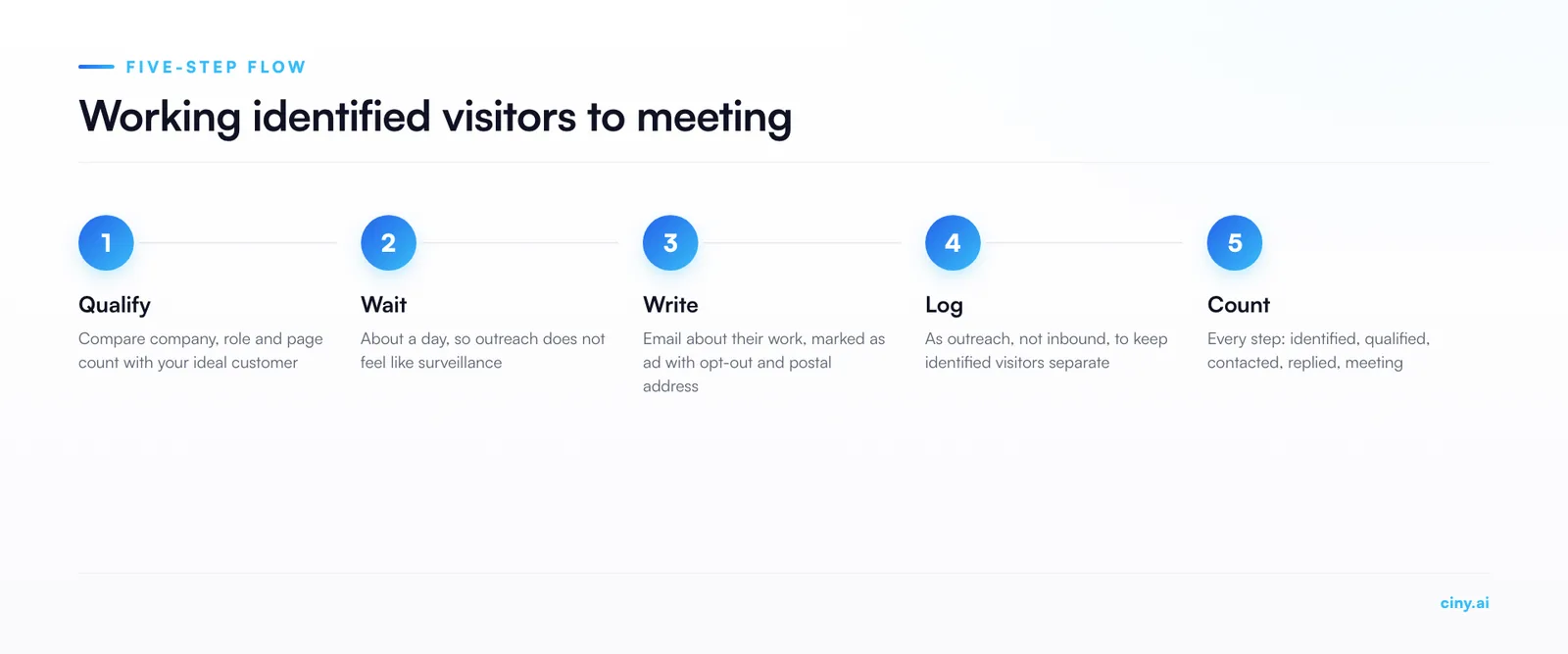
Treat each identified visitor as a prospect to qualify, not a lead to chase. Qualify the fit, wait about a day, write about their work, log it as outreach and count every step.
- Qualify first. Compare company, role and page count with your ideal customer. A competitor or a job seeker reading your pricing page is not a prospect.
- Wait about a day. Ruh AI's rule, recorded at its 16 September 2026 stand-up, is to wait about a day so outreach does not feel like surveillance.
- Write about their work. A first line about the reader's problem gives them a reason to reply. A first line about the pages they viewed tells them they were watched. Every email says it is an ad and carries a clear opt-out and your postal address, and opt-outs are honoured within 10 business days.
- Log it as outreach. A separate source tag keeps identified visitors out of your inbound count, so you can still see how many people your site persuades to get in touch.
- Count every step. Identified, qualified, contacted, replied, meeting. Without the middle steps, a figure such as 56 outreach leads cannot become a pipeline figure.
Where is the privacy line for website visitor identification?
For a US-facing B2B site, RB2B's and the FTC's guidance puts the line in three places. Your privacy policy says visits may be linked to other information about the visitor and links to an opt-out. Any cookie consent tool you use holds the script until the visitor agrees. Every marketing email says it is an ad and carries an opt-out and your postal address.
Which laws apply depends on your business and where your visitors are, so confirm it with your own counsel. What follows is a starting point for that conversation, not legal advice.
- On your site. RB2B's compliance page says US state privacy laws such as California's CCPA and CPRA "may apply to you, if you handle substantial amounts of data, have sufficient revenue, and have consumers in the relevant states." Where California's law applies, the page lists website disclosures that you are "sharing" personal information and a way for people to delete or access the data you hold about them. It offers privacy policy wording that says visits may be linked to other information about the visitor, with an opt-out link, and advises "that you talk to your own privacy counsel".
- Cookie consent. RB2B's help centre says a site using a cookie consent tool other than CookieYes must configure it to delay RB2B's script until the visitor grants consent.
- Outside the US. RB2B's homepage says GDPR does not apply to its person-level identification, because its database "only contains profiles that have been matched to US home addresses" and it uses IP ringfencing to resolve only US traffic. Company-level tracking of visitors outside the US is different. RB2B's Global Visitor Tracking article, dated 9 March 2026, says it is on by default on the Starter, Pro and Pro+ plans and can be switched off under Account Details. It says "RB2B does not automatically enforce consent compliance", and asks you to add GDPR opt-out information to your privacy policy and to have your legal or compliance team review the requirements. The homepage says consent capture is required for this global identification.
- In the inbox. The FTC's CAN-SPAM guide says: "The law makes no exception for business-to-business email." Each marketing email needs accurate sender and subject details, a clear way to opt out and "your valid physical postal address". You must also "disclose clearly and conspicuously that your message is an advertisement", and the guide says you stay responsible when another company sends the email for you. It adds: "You must honor a recipient's opt-out request within 10 business days." Each email in violation can draw penalties of up to $53,088.
- The law is moving. California's SB 690 (Chapter 976 of 2026) was approved by the Governor on 30 September 2026. It limits who can sue under section 638.51 of the California Invasion of Privacy Act, the pen-register and trap-and-trace section, which Morgan Lewis says has been "a significant driver of class-action litigation" since 2023, much of it over third-party cookies and other advertising technology on websites. The bill's text says such a claim against a private actor over conduct on a website or app "may be brought under this section only by the Attorney General". Claims under sections 631 and 632 remain open to plaintiffs, and the firm suggests businesses reassess cookie consent, tracking technologies and privacy disclosures.
What do B2B marketers get wrong about visitor identification?
Our view: A named visit is a reason to research, not a reason to pitch. The profile tells you who looked. It does not tell you what they need, so the first message has to earn its reply.
Start at company level. Company-level identification, which RB2B offers on a free plan, shows whether your target accounts visit at all before you pay to see people.
Build the suppression list before the outreach list. Customers, open deals, competitors and anyone who has opted out should never receive a cold message, and that check belongs before the first send.
The identified-visitor working template
Copy this into your CRM, your outreach tool or the Slack channel where profiles arrive, or download the template as a Markdown file. No email needed. Run the first three checks once when you set up, and the rest on every identified visitor.
- Consent tool. If your site uses a cookie consent tool, it holds the identification script until the visitor agrees.
- Outside the US. Company-level tracking of visitors outside the US is switched off, or runs behind a consent tool.
- Privacy policy. It carries the vendor's disclosure and opt-out wording, reviewed by your counsel.
- Fit. The company fits your ideal customer on industry, size and region, and the role can buy or influence a purchase.
- Not excluded. The person is not a customer, an open deal, a competitor, a job seeker or someone who has opted out.
- Wait. First contact is no earlier than the visit date plus 1 day.
- First line. It is about their work, not the visit.
- Headers. Sender name, reply address and subject line are accurate.
- Ad disclosure. The email says clearly that it is an advertisement.
- Opt-out and address. Every marketing email carries a clear opt-out line and your postal address.
- Opt-outs honoured. Within 10 business days, on one list that every sending tool checks.
- Senders covered. Any agency or tool that sends for you follows the same rules, because the responsibility stays with you.
- No guessed addresses. No email address is guessed for a visitor without a matched profile.
- Source tag. "Identified visitor (outreach)", never "Inbound".
- Weekly count. Identified, qualified, contacted, replied, meetings and opt-outs.
Then fill in a log card for each name.
Source: Identified visitor (outreach), not inbound
Name, company, role:
Last seen and page count:
Fit: yes or no, and why
First contact no earlier than: visit date + 1 day
Opt-out received on: (date)    Honoured on: (date, within 10 business days)
Outcome: no reply / reply / meeting / opted out
For a sheet or a CRM import, use these column headings.
Source,Name,Company,Role,Last seen,Page count,Fit,Fit reason,First contact no earlier than,Opt-out received,Opt-out honoured,Outcome
Frequently asked questions
Can you identify website visitors by name?
Yes, for some US visitors, with a person-level tool. RB2B names only visitors it can match in the US. Outside the US it identifies companies at most, and it says that company-level tracking needs a consent tool on your site. Visitors it cannot match stay anonymous.
How much does website visitor identification cost?
With RB2B, company-level identification is free, person-level identification starts at $79 a month without email addresses, and business email addresses start on the Pro plan, from $149 a month. Add the time your team spends qualifying and writing to each name.
Is website visitor identification legal?
It can be, but the answer turns on your business, where your visitors are and how you use the data, so ask your own counsel. Take three things to that conversation: your privacy policy wording, your cookie consent set-up and the opt-out process for every email you send.
Should identified visitors count as leads?
Count them as outreach leads, kept separate from inbound leads. Tag the source when the profile arrives, so your reports show both numbers side by side.
How long should you wait before contacting an identified visitor?
Ruh AI's rule is about a day after the visit, so the message does not read like surveillance. Whatever rule you choose, write it down and apply it to every identified visitor.
How this article was made
This article was drafted with Ciny's content system and AI assistance, from Ruh AI's marketing stand-up notes of 16 and 21 September 2026. Every external claim was checked against the sources below on 6 October 2026. Nirmal takes part in Ruh AI's marketing stand-ups and set up the visitor identification tool described here. This article is not legal advice.
Sources
External sources, all checked on 6 October 2026:
- RB2B homepage, including its FAQ on US coverage, GDPR and global company-level identification: https://www.rb2b.com/
- RB2B pricing page: https://www.rb2b.com/pricing
- RB2B compliance page: https://www.rb2b.com/compliance
- RB2B help centre, What is RB2B and how does it work?, dated 20 April 2026: https://support.rb2b.com/en/articles/8891294-what-is-rb2b-and-how-does-it-work
- RB2B help centre, Global Visitor Tracking, dated 9 March 2026: https://support.rb2b.com/en/articles/11185399-global-visitor-tracking
- RB2B help centre, Viewing Identified Visitors, dated 19 June 2025: https://support.rb2b.com/en/articles/8871017-viewing-identified-visitors
- Federal Trade Commission, CAN-SPAM Act: A Compliance Guide for Business: https://www.ftc.gov/business-guidance/resources/can-spam-act-compliance-guide-business
- California Legislative Information, SB-690 Crimes: invasion of privacy, chaptered 30 September 2026: https://leginfo.legislature.ca.gov/faces/billNavClient.xhtml?bill_id=202520260SB690
- Morgan Lewis, California Eliminates Private Right of Action Under CIPA's "Pen Register" and "Trap and Trace" Provision, 1 October 2026: https://www.morganlewis.com/pubs/2026/10/california-eliminates-private-right-of-action-under-cipas-pen-register-and-trap-and-trace-provision
Our own evidence, from one company's marketing team, not a study:
- Ruh AI marketing stand-up notes, 21 September 2026: RB2B visitor identification live, and 56 leads for cold outreach in the previous 17 days.
- Ruh AI marketing stand-up notes, 16 September 2026: the visitor identification tool at about $150 a month, profiles sent to Slack, and the rule to wait about a day before outreach.
What should you do next?
Run the first three checks on your site this week, then work your next identified visitor through the template and tag that name as outreach, not inbound.
If you want your site to turn more visits into enquiries, talk to Ciny.